Fearful-Avoidant Breakup Recovery: The Push-Pull Grief Cycle and How to Break It
Introduction
If you just got out of a relationship with a fearful-avoidant partner, the confusion you’re feeling right now isn’t a sign that something is wrong with you. It’s a sign that your nervous system is trying to process two contradictory realities at once: the person who made you feel deeply loved is the same person who disappeared without warning.
I call this the Push-Pull Grief Cycle, and it’s the single biggest reason standard breakup advice fails after a fearful-avoidant relationship. You can’t just ‘move on’ or ‘give it time’ when your brain is still toggling between hope and abandonment on a 48-hour loop.
Quick Answer: Fearful-avoidant breakup recovery takes longer than typical breakup recovery because the intermittent reinforcement pattern (hot-cold, close-distant) creates a neurochemical dependency similar to addiction withdrawal. Recovery requires three specific phases: nervous system stabilization (weeks 1-4), pattern recognition (weeks 5-12), and attachment recalibration (months 3-6).
Most online advice about fearful-avoidant breakups focuses on getting your ex back. This article doesn’t. It focuses on getting you back. Here’s the mechanism-based recovery protocol I recommend for FA-specific healing.

Why Fearful-Avoidant Breakups Hurt Differently Than Other Breakups
In a typical breakup, the grief follows a mostly linear path. You’re sad, then angry, then you start rebuilding. In a fearful-avoidant breakup, the grief cycles. One hour you’re furious they left. The next hour you’re convinced it was your fault. By evening you’re checking their social media for signs they miss you. By midnight you’re relieved it’s over.
This isn’t emotional instability on your part. It’s your brain mirroring the exact attachment pattern you were conditioned into during the relationship.
Here’s the mechanism: fearful-avoidant partners create what attachment researchers call intermittent reinforcement. The closeness was unpredictable. Sometimes they were fully present, emotionally available, and deeply loving. Other times they withdrew without explanation, went cold, or created conflict out of seemingly nothing. Your nervous system adapted to this pattern by staying in a constant state of hypervigilance, always scanning for which version of your partner would show up next.
When the relationship ends, that scanning doesn’t stop. Your brain keeps cycling through hope and despair because it was literally trained to do that over months or years. Research on attachment disruption shows that individuals recovering from fearful-avoidant relationships show elevated cortisol levels and attachment anxiety compared to those healing from secure relationship endings. The neurobiological impact involves dysregulation of the stress-response system, leading to heightened reactivity and difficulty processing relationship memories in a coherent way.
This is why you feel like you’re going crazy. You’re not. Your nervous system is running an outdated program, and it hasn’t received the signal that the relationship is actually over.
I recommend tracking these cycles in writing rather than trying to think through them. When the pull toward reaching out hits, document the exact thought, the physical sensation in your body, and what happened in the 30 minutes before the urge started. Most people discover their cycles are predictable once externalized. Untangle Your Thoughts includes a pattern-tracking framework specifically designed for this kind of cyclical emotional processing, where the same feelings keep looping rather than resolving.
Key Points
- FA breakup grief cycles rather than progressing linearly due to intermittent reinforcement conditioning
- Your nervous system was trained to toggle between hope and abandonment during the relationship itself
- Elevated cortisol and attachment anxiety persist longer after FA breakups than after secure relationship endings
- The cycling is a neurological pattern, not emotional weakness
Practical Insights
- Track your emotional cycles in writing instead of trying to reason through them internally
- Note what happens in the 30 minutes before each urge to reach out (trigger identification)
- Use the pattern-tracking framework in Untangle Your Thoughts to externalize recurring emotional loops
The Push-Pull Grief Cycle: What’s Actually Happening in Your Brain
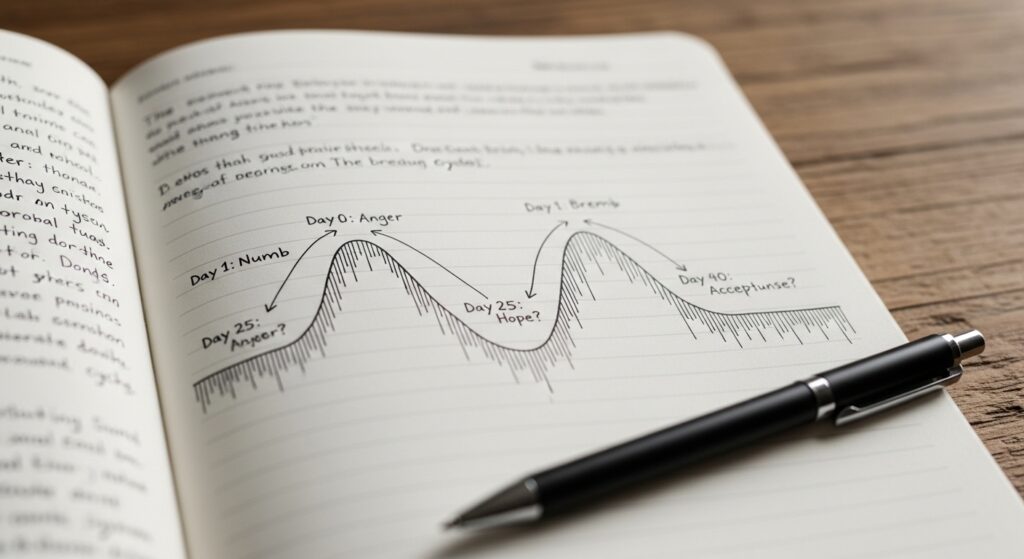
The Push-Pull Grief Cycle has four distinct phases that repeat on a roughly 2-7 day rotation in the first month after a fearful-avoidant breakup. Recognizing which phase you’re in removes a significant amount of the confusion.
Phase 1: Relief and Clarity. This is the exhale. You feel lighter. The walking-on-eggshells vigilance is gone. You can think clearly for the first time in months. You might even feel guilty about how good the relief feels. This phase typically lasts 12-48 hours.
Phase 2: The Nostalgia Flood. Your brain starts selectively editing the relationship highlight reel. The good moments play on repeat. The fear, confusion, and cold withdrawals get filtered out. This is not accurate memory recall. This is your attachment system attempting to reestablish the bond by romanticizing the source of intermittent reinforcement. This phase is when most people break no-contact.
Phase 3: Anger and Betrayal. The rose-tinted filter drops and you see the pattern clearly. The hot-cold behavior. The withdrawals. The times you abandoned your own needs to accommodate their discomfort with closeness. This phase can feel empowering, but it’s unstable because it often tips into self-blame.
Phase 4: Self-Doubt and Rumination. The anger turns inward. ‘What if I’d been less needy?’ ‘What if I hadn’t pushed for commitment?’ ‘What if I’m the one with the attachment problem?’ This is the most dangerous phase because it erodes your ability to trust your own perceptions, which is exactly the dynamic that kept you stuck in the relationship.
Then the cycle resets back to Phase 1.
I recommend marking which phase you’re in each morning for the first 30 days. This simple act of labeling creates cognitive distance between you and the emotion. You stop being consumed by the feeling and start observing it as a pattern with predictable movement. Knowing ‘I’m in Phase 2 right now’ gives you the power to wait it out rather than act on it.
Lunar Insight can be particularly useful here because FA grief cycles often intensify around hormonal shifts and sleep disruption. Tracking emotional patterns alongside physical rhythms reveals connections that pure journaling misses.
Key Points
- Phase 1 (Relief) lasts 12-48 hours and is the nervous system exhaling from hypervigilance
- Phase 2 (Nostalgia Flood) is selective memory editing by the attachment system, not accurate recall
- Phase 3 (Anger) provides clarity but often destabilizes into self-blame
- Phase 4 (Self-Doubt) erodes self-trust and mirrors the dynamic that sustained the relationship
Practical Insights
- Label which phase you’re in each morning for the first 30 days
- Do not make contact decisions during Phase 2 (Nostalgia Flood) or Phase 4 (Self-Doubt)
- Use Lunar Insight to track emotional cycles alongside physical rhythms for deeper pattern recognition
Phase 1 Recovery Protocol: Nervous System Stabilization (Weeks 1-4)
The first four weeks after a fearful-avoidant breakup aren’t about healing. They’re about stabilization. Your nervous system has been running in threat-detection mode for potentially years. The goal right now isn’t to process the relationship or understand what happened. The goal is to bring your baseline stress response down to a level where clear thinking becomes possible.
Here’s what stabilization actually looks like:
Sleep architecture repair comes first. FA relationships commonly disrupt sleep because hypervigilance doesn’t shut off at bedtime. If you’ve been waking at 2-4 AM with racing thoughts or an inability to fall asleep without checking your phone, that’s your cortisol cycle misfiring. Set a hard boundary: phone charges in another room after 9 PM. This single change removes the two biggest sleep disruptors, the blue light stimulation and the compulsive checking.
Physical discharge is non-negotiable. The hypervigilance energy has to go somewhere. If you don’t discharge it intentionally through movement, it will discharge through rumination, compulsive texting, or anxiety spirals. Twenty minutes of elevated heart rate exercise daily is more effective than any amount of thinking or talking during this phase. Walking counts if it’s brisk enough to slightly elevate your breathing.
Contact boundaries need to be binary, not flexible. ‘Maybe I’ll respond if they reach out’ keeps your threat-detection system active because it requires constant decision-making. Decide once: either you respond to contact or you don’t. Either you check their social media or you don’t. The decision itself matters less than its consistency. Your nervous system calms down when the uncertainty is removed.
I tell people to think of the first four weeks as physical recovery, not emotional recovery. You’re treating the physiological aftermath of sustained stress. The emotional processing comes next, but it can’t happen effectively on a dysregulated nervous system.
If you find yourself unable to resist the pull to analyze the relationship during this phase, redirect that energy into structured writing. The externalization exercises in Untangle Your Thoughts give the analytical part of your brain something productive to do while keeping the focus on your patterns rather than your ex’s behavior.
Key Points
- Weeks 1-4 focus on nervous system stabilization, not emotional processing
- Sleep repair is the highest-priority intervention during this phase
- Physical discharge through exercise prevents rumination and anxiety spiraling
- Contact decisions should be binary (yes or no) to reduce ongoing threat-detection load
Practical Insights
- Phone charges in another room after 9 PM starting tonight
- Twenty minutes of elevated heart rate movement daily (walking counts)
- Make one contact decision and stick to it for 30 days without re-evaluating
Phase 2 Recovery Protocol: Pattern Recognition (Weeks 5-12)
Once your nervous system has stabilized, the real work begins. Pattern recognition is where you identify exactly how the fearful-avoidant dynamic shaped your behavior, your self-perception, and your tolerance for relationship instability.
The question most people ask at this stage is ‘Why did they do this to me?’ I redirect that question to one that actually produces recovery: ‘What did I learn to tolerate, and when did I learn it?’
Fearful-avoidant relationships don’t happen in a vacuum. If you stayed through the push-pull cycle for an extended period, something in your own attachment history made that pattern feel familiar enough to endure. This isn’t blame. This is the recognition that understanding your own patterns is the only variable you can actually change.
The three patterns I see most frequently in people recovering from FA relationships are accommodation overdrive, where you learned to suppress your own needs to prevent their withdrawal. Hypervigilance as love, where you interpreted constant emotional scanning as caring deeply. And reality-testing collapse, where you stopped trusting your own perceptions because their version of events consistently contradicted your experience.
Accommodation overdrive shows up as exhaustion that lifts after the breakup. If you feel more energetic single than you did in the relationship, you were likely spending enormous resources managing their emotional state at the expense of your own.
Hypervigilance as love reveals itself when you notice the absence of anxiety and mistake it for the absence of feelings. If calm relationships feel boring to you, your nervous system has been calibrated to equate activation with attachment.
Reality-testing collapse is the most serious pattern because it affects your ability to make decisions in all areas of life, not just relationships. If you frequently second-guess your own memories, perceptions, or emotional responses, this pattern needs specific attention.
I recommend working through these patterns in writing over a 6-8 week period. Structured reflection tools like those in Untangle Your Thoughts provide the framework for identifying these patterns without spiraling into self-criticism. The goal is recognition, not rumination.
Key Points
- Recovery question shifts from ‘Why did they do this?’ to ‘What did I learn to tolerate?’
- Accommodation overdrive: suppressing your needs to prevent their withdrawal
- Hypervigilance as love: equating anxiety and scanning with genuine caring
- Reality-testing collapse: losing trust in your own perceptions due to contradictory narratives
Practical Insights
- Notice if you feel more energetic post-breakup (accommodation overdrive indicator)
- Monitor whether calm interactions feel boring (hypervigilance-as-love indicator)
- Track how often you second-guess your own memories or perceptions (reality-testing indicator)

Phase 3 Recovery Protocol: Attachment Recalibration (Months 3-6)
Attachment recalibration is the phase most people skip because they feel better and assume they’re healed. They’re not healed. They’ve stabilized and they’ve gained insight, but the underlying attachment calibration that made the FA relationship feel like home hasn’t changed yet.
Recalibration means your nervous system learns to recognize safety as attractive rather than boring, and consistency as loving rather than suspicious.
This happens through daily micro-experiences, not through one breakthrough realization. Every time you honor a commitment to yourself, follow through on a boundary, or sit with boredom without reaching for stimulation, you’re laying down new neural pathways. Every time you notice a predictable, kind interaction and register it as pleasant rather than dismissing it as ‘not exciting enough,’ you’re recalibrating.
The timeline for meaningful recalibration is typically 3-6 months of consistent practice. This isn’t a motivational estimate. It reflects the actual neuroplasticity timeline for rewiring stress-response patterns according to attachment research.
During this phase, I recommend three specific practices:
First, build a reliability inventory. Document every person in your life who shows up consistently. Call when they say they will. Follow through on plans. Don’t cancel without reason. Your brain needs concrete evidence that reliability exists before it can start valuing it in romantic partners.
Second, practice tolerating predictability. If you notice yourself creating drama, seeking conflict, or gravitating toward intensity in any area of life, that’s the old calibration running. Name it: ‘My system is looking for activation because it mistakes activation for connection.’
Third, establish a personal boundary enforcement record. Each time you maintain a boundary, even a small one, log it. Your tolerance for boundary violations in the FA relationship eroded your enforcement confidence. Rebuilding it requires documented evidence that you can and will protect your own limits.
Lunar Insight supports this phase by helping you track emotional patterns over longer cycles. Attachment recalibration doesn’t happen in a straight line, and being able to see your baseline emotional state shifting over weeks and months provides the evidence your brain needs to trust the process.
Key Points
- Feeling better does not mean the underlying attachment calibration has changed
- Recalibration teaches your nervous system to register safety as attractive, not boring
- Neuroplasticity timeline for stress-response rewiring is typically 3-6 months of consistent practice
- Daily micro-experiences build new neural pathways more effectively than single breakthroughs
Practical Insights
- Build a reliability inventory documenting people who show up consistently in your life
- Name the pattern when intensity-seeking appears: ‘My system is mistaking activation for connection’
- Log every boundary you enforce to rebuild enforcement confidence
When Standard No-Contact Advice Backfires with FA Breakups
Most no-contact advice assumes a clean break: they left, you stop reaching out, time heals. With fearful-avoidant breakups, the break is rarely clean. FA exes frequently initiate contact days or weeks after ending things. They might send a casual text as if nothing happened. They might reach out during a vulnerable moment. They might oscillate between wanting you back and reinforcing the breakup.
This is the push-pull dynamic continuing past the relationship’s official end, and it’s the single biggest threat to your recovery.
Here’s why standard no-contact advice falls short: it assumes the challenge is managing your urge to reach out. In FA recovery, the bigger challenge is managing their reaching in. Each time they make contact, your nervous system reactivates the hope-despair cycle. Your cortisol spikes. The four grief phases restart from Phase 2 (Nostalgia Flood). Weeks of stabilization work can be undone by a single ‘hey, I’ve been thinking about you’ text.
I recommend what I call Structured Disengagement rather than traditional no-contact. Structured Disengagement has three components:
First, response delay protocol. If you choose to remain open to contact, establish a minimum 24-hour response window. This prevents the reactive, emotionally-driven replies that keep the push-pull cycle active. Write your response, save it as a draft, and revisit it 24 hours later. Most people find they don’t send the draft.
Second, content boundaries. If you do respond, restrict communication to logistical matters only. No emotional processing, no relationship discussion, no ‘how are you doing’ exchanges. These conversations feel connective in the moment and trigger grief cycling within hours.
Third, exit criteria. Define in advance what would cause you to move from Structured Disengagement to full no-contact. Write it down. When you’re in Phase 2 of the grief cycle, you’ll rationalize staying engaged. Your pre-written exit criteria protect you from decisions made under attachment activation.
The Untangle Your Thoughts framework for externalizing decision-making is built for exactly this kind of situation, where your emotional state actively works against your recovery goals.
Key Points
- FA exes frequently reinitiate contact, reactivating the push-pull cycle post-breakup
- Standard no-contact focuses on your outreach; FA recovery must also manage their reaching in
- Structured Disengagement uses response delays, content boundaries, and pre-set exit criteria
- Each unstructured contact resets grief cycling and can undo weeks of stabilization
Practical Insights
- Institute a 24-hour minimum response delay for any contact from your ex
- Restrict any responses to logistics only, zero emotional processing via text
- Write your exit criteria now while clear-headed, before the next contact attempt
Conclusion
Fearful-avoidant breakup recovery isn’t about getting over someone. It’s about dismantling a neurological pattern that was installed over months or years of intermittent reinforcement. The Push-Pull Grief Cycle will run on its own until you intervene with structure, awareness, and consistent self-directed action.
The three-phase protocol (stabilization, pattern recognition, recalibration) works because it addresses the actual mechanism rather than treating the symptoms. You don’t need to understand why your FA ex behaves the way they do. You need to understand why your nervous system adapted to it and what it takes to recalibrate.
Your attachment patterns are learned. That means they can be relearned. It takes longer than most advice suggests, it requires more structure than most people expect, and it demands honest self-examination that goes beyond analyzing your ex’s behavior. But the outcome is worth it: a nervous system that recognizes safety, a relationship template built on consistency rather than intensity, and a version of you that doesn’t confuse anxiety with love.
Frequently Asked Questions
How long does it take to recover from a fearful-avoidant breakup?
Recovery from a fearful-avoidant breakup typically takes 4-6 months with consistent, structured work. This is longer than typical breakup recovery because the intermittent reinforcement pattern creates a neurochemical dependency that requires nervous system stabilization (weeks 1-4), pattern recognition (weeks 5-12), and attachment recalibration (months 3-6). The timeline extends if the relationship lasted several years or involved cohabitation.
Why do I keep going back and forth between missing my FA ex and feeling relieved they’re gone?
This cycling is the Push-Pull Grief Cycle. Your nervous system was conditioned by the relationship’s hot-cold pattern to toggle between hope and abandonment. The cycling mirrors the intermittent reinforcement you experienced during the relationship. It typically rotates on a 2-7 day cycle in the first month and gradually lengthens as your nervous system stabilizes.
Should I go no contact with a fearful-avoidant ex?
Structured Disengagement is more effective than traditional no-contact for FA breakups. This includes a minimum 24-hour response delay, restricting any communication to logistics only, and establishing pre-written exit criteria for when to move to full no-contact. The key difference is that FA exes often reinitiate contact, so you need a protocol for managing their reaching in, not just your reaching out.
Is it normal to feel worse before feeling better after an FA breakup?
Yes. During weeks 2-4, the initial relief fades and the full weight of the grief cycle activates. Many people report this as the hardest period because the hypervigilance that masked the pain during the relationship is subsiding, allowing suppressed emotions to surface. This intensification is actually a sign that your nervous system is beginning to process rather than suppress.