How to Build an Online Dating Profile After a Breakup: The Signal Framework That Attracts the Right Match
Introduction
Most online dating profile advice treats every user the same: pick a good photo, write something witty, mention your love of hiking. That advice doesn't account for what you're actually navigating — building a profile after a breakup, when your identity has just been restructured and you're not entirely sure who you are yet, let alone how to present yourself to strangers.Here's what that context changes: your profile doesn't just describe you. It signals your readiness.After years of guiding women through post-breakup recovery and back into dating, I've identified a consistent pattern. The profiles that attract compatible, emotionally available partners are built around five specific signals. The profiles that attract unavailable, confusing, or emotionally exhausting matches are built around everyone else's profile advice.Quick Answer: A strong post-breakup dating profile requires more than good photos and a witty bio. It requires The Signal Framework — five elements that communicate emotional readiness, self-knowledge, and clear expectations to the exact type of person you actually want to match with.This isn't about performing a version of yourself that looks recovered. It's about building a profile that reflects who you actually are now — someone who has come through something hard and has a much clearer idea of what she wants next.

Why Post-Breakup Profiles Fail (And What They Signal Instead)
There's a specific type of online dating profile that reads like a breakup recovery project. It over-explains what the person doesn't want. It's heavy on who they are now compared to who they were. It name-drops 'independence' and 'not looking for anything serious right now' in the bio. The photos were clearly taken in a rush. The energy is defensive.
Compatibility-minded partners read these signals immediately — and most of them swipe away.
I call this the Post-Breakup Profile Trap: creating a profile that's optimized for your healing needs rather than for genuine connection. It makes sense emotionally. But it reliably attracts the wrong matches or no matches at all.
Here's the mechanism. When someone reads your profile, they're running a quick compatibility algorithm in their head — not for stats, but for energy. Are you available? Do you know yourself? Are you looking for something real? Do you seem like someone I could actually talk to?
A profile built from recent wound rather than from recovered clarity fails this algorithm at every point. Not because you're not ready to date — you might be. But because the profile communicates unavailability even when the words say otherwise.
The most common signals that a post-breakup profile is too early or too defensive: - Bio focuses on what you're not looking for (communicates hypervigilance, not clarity) - Photos are all solo, very recent, and formal (communicates rebuild mode, not settled self) - Interests listed are aspirational, not actual (communicates performance, not authenticity) - Opener is a disclaimer ("I'm just getting back out there" is a warning label, not an invitation) - Tone is either too casual ("just seeing what's out there") or too intense ("looking for my forever person")
Neither end of that spectrum attracts what you actually want. The goal is calibrated clarity — knowing who you are, what you want, and communicating both without apology or over-explanation.
This is what The Signal Framework addresses.
Key Insights: - A profile built from recent wound signals unavailability regardless of what it says - Compatibility-minded partners read energy before they read words - The most common post-breakup profile mistakes are defensive, aspirational, or apologetic - Calibrated clarity — not perfection — is what attracts emotionally available matches
Put It Into Practice: - Before building or revising your profile, ask: "Does this profile reflect who I actually am right now, or who I'm trying to seem like?" - Read your bio out loud — does it sound like someone you'd want to date, or like someone who's been hurt and is being careful? - If your opener includes a disclaimer, delete it
Key Points
- Post-Breakup Profile Trap: optimizing for healing needs rather than genuine connection
- Profiles communicate energy before they communicate words
- Defensive, aspirational, or apologetic profiles reliably attract poor matches
- Calibrated clarity — knowing who you are now — outperforms performed recovery
Practical Insights
- Audit your profile for disclaimers, future-focused language, and over-explanation of what you don't want
- If you wrote your bio within 2 months of your breakup, rewrite it — your identity had not fully restabilized yet
- Use <a href="https://inwardreflectionsbooks.com/untangle-your-thoughts/">Untangle Your Thoughts</a> to clarify your values and patterns before building the profile — that work creates authentic profile material
The Signal Framework: Five Elements That Attract Compatible Matches
The Signal Framework identifies five elements that emotionally available, compatible partners consistently respond to. These aren't about appearing perfect — they're about communicating the specific qualities that healthy partners are screening for.
Signal 1: Emotional Grounding (Not Cheerfulness)
There's a difference between a profile that reads as forced positivity and one that reads as settled. Forced positivity uses phrases like "I love life," "always smiling," and "looking for someone to share adventures with." These are signals of performed wellness.
Grounded profiles read as specific and honest: "I make excellent coffee and terrible breakfast food. I'm most myself in small groups." Specific, real details communicate that the person knows themselves — which is the most attractive signal you can send post-breakup.
The practical rule: replace any adjective you'd use in a performance review ("passionate," "driven," "positive," "adventurous") with a specific, true statement about how you actually spend your time.
Signal 2: Self-Knowledge Without Over-Disclosure
Post-breakup, you often have more self-knowledge than you did when you were in the relationship. That's genuinely valuable. The mistake is over-disclosing it in the profile: explaining your attachment style, what your last relationship taught you, what you're working on. That's therapy content, not dating profile content.
Self-knowledge in a profile shows up indirectly: you know what you value, you know what you enjoy, you know what you want. You don't explain why you know it.
Signal 3: Specific Availability
Vague availability — "looking for something real," "open to where it goes" — is one of the most common profile mistakes. It reads as non-commitment or as being too early to know what you want.
Specific availability means stating clearly (without a paragraph) what you're actually open to. If you're ready for a relationship, say you're looking for something serious. If you're genuinely not sure yet, micro-dating is the right approach — <a href="https://www.thebreakupsource.com/micro-dating/">see how micro-dating works post-breakup</a> before you commit to a profile framing that doesn't match your readiness.
Signal 4: Active Life Evidence (Not Aspirational Life Claims)
Photos and bio details that show an actual, active life — not a curated one — signal stability. The difference: listing "hiking, travel, cooking" as interests is aspirational. A photo from an actual recent hike, a mention of the specific cuisine you cooked last weekend, a reference to a book you actually finished — these are evidence signals, not claims.
Evidence beats claims in profile communication every time. Anyone can write "adventurous." Fewer people have a candid photo that proves it.
Signal 5: Relaxed Selectivity
The most attractive profiles communicate that the person has standards without advertising them defensively. This is the hardest signal to get right post-breakup, because you've likely just updated your standards based on recent experience.
Relaxed selectivity sounds like: knowing what matters to you and mentioning it once, in a neutral tone. It does not sound like a list of dealbreakers, a set of requirements, or a warning about what you won't tolerate. The energy of those things is what communicates — and defensive selectivity communicates fear, not discernment.
Key Insights: - Five signals: Emotional Grounding, Self-Knowledge Without Over-Disclosure, Specific Availability, Active Life Evidence, Relaxed Selectivity - Grounded profiles use specific true details, not adjective-based self-descriptions - Self-knowledge shows in what you say you value, not in how you explain yourself - Evidence (specific details, real photos) outperforms claims (adjectives, aspirational lists) - Relaxed selectivity communicates discernment; defensive selectivity communicates fear
Put It Into Practice: - Audit your bio for adjectives — replace each one with a specific, true statement - Check your availability framing — does it match your actual readiness right now? - Read your tone: does it communicate fear or discernment? Settle vs. defend?
Key Points
- Signal 1: Emotional Grounding — specific true details over performed positivity
- Signal 2: Self-Knowledge Without Over-Disclosure — show what you value, don't explain why
- Signal 3: Specific Availability — vague 'seeing where it goes' reads as unready
- Signal 4: Active Life Evidence — real details over aspirational claims
- Signal 5: Relaxed Selectivity — standards communicated once, without defensiveness
Practical Insights
- Replace every adjective in your bio with a specific true statement about how you actually spend your time
- Check your availability framing against your actual readiness — a mismatch here causes early incompatibility
- If micro-dating suits your readiness better than serious dating, read <a href="https://www.thebreakupsource.com/micro-dating/">how micro-dating works post-breakup</a> before framing your profile
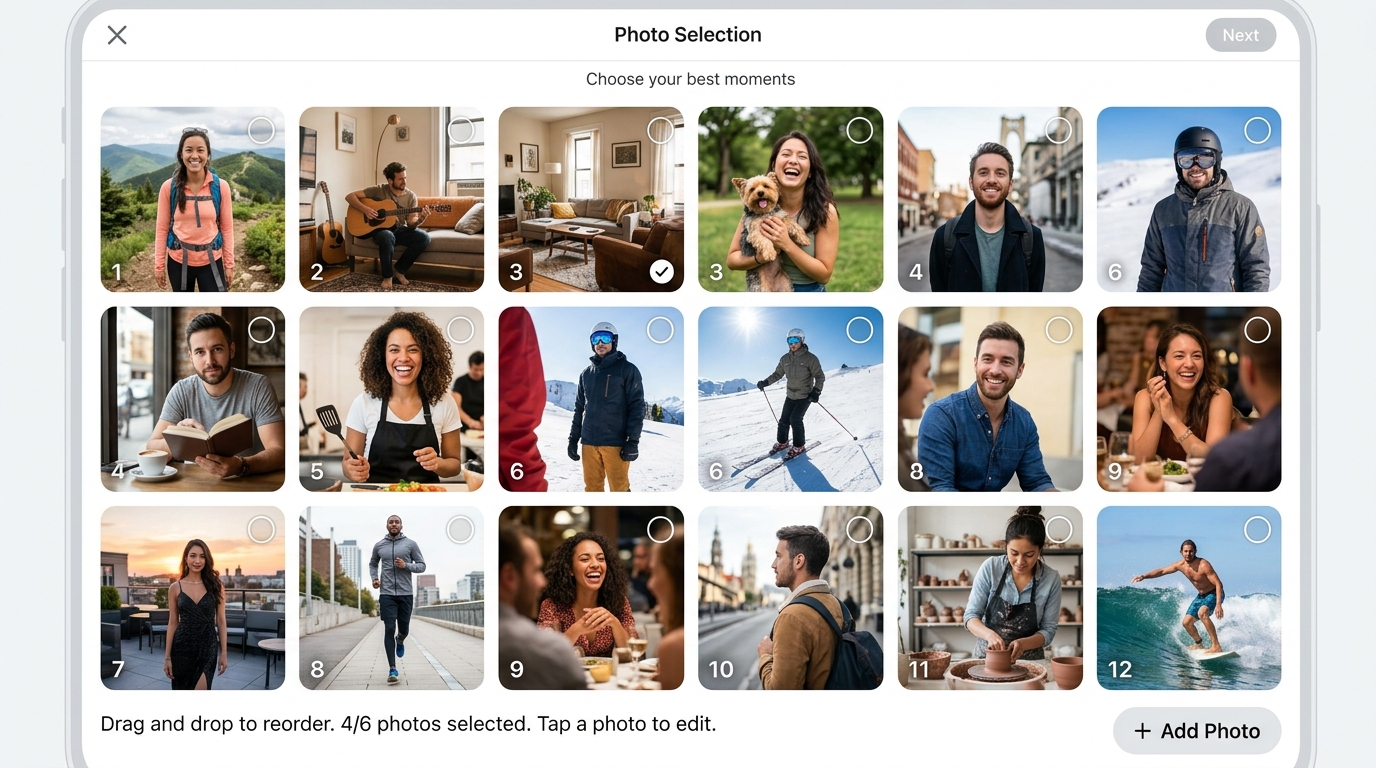
The Photo Selection Protocol: What Each Photo Communicates
Your photos do more communication work than your bio. Before anyone reads a word you've written, they've already made a preliminary assessment based on your photo set. Understanding what each photo slot communicates lets you curate strategically, not randomly.
The Primary Photo: Settled Presence
The primary photo should communicate settled presence — a clear, well-lit image where you look like yourself, not like you're trying to look like someone. The most common post-breakup primary photo mistake is choosing a photo from a specific event (the night out, the dressed-up occasion) that reads as effortful rather than natural.
Best performing primary photos: natural light, genuine expression, minimal backdrop competition. You looking at the camera with an expression that communicates that you are exactly where you're supposed to be.
Avoid: heavy filters, group photos as primaries (forces people to identify you), photos from significantly different life stages (if you've changed substantially post-breakup, your primary should reflect now).
The Context Photo: Evidence of Life
This is the photo that proves your bio. If you mentioned a hobby, this is where it lives — not a posed version of it, but a real moment in it. If you listed reading as an interest, a candid of you at a bookshop outperforms a staged photo of you holding a book.
The context photo is also where personality comes through. A photo that makes the viewer smile, or that prompts a natural opening line, does significant matching work.
The Social Photo: Evidence of Relationships
A photo with friends or family signals that you have a life outside of dating — that you're adding someone to an existing, full life, not asking them to become your life. Post-breakup, this photo matters more than ever, because it counters the implicit concern that you might be seeking a replacement rather than a partner.
Guidelines: group of 2-4 people, you clearly identifiable, natural setting, recent.
The Wildcard Photo: The Unexpected Detail
This is the photo that doesn't fit the obvious categories — the one that reveals something specific and real about you that your bio doesn't capture. It's also the photo that generates the most opening messages, because it gives people something concrete to reference.
Examples: you at an unusual location that means something to you, a photo from an activity that's not on most profiles, a candid from a moment of genuine enjoyment (not photogenic enjoyment).
What to Remove
- Photos where an ex has been cropped out (the ghost arm is always visible) - Photos with children unless they are yours and you've decided to disclose that upfront - Photos that are more than 2 years old if you've changed substantially - Mirror selfies as the primary photo (communicate early-stage effort, not settled presence) - Group photos where you're the least visually prominent person
Key Insights: - Primary photo communicates settled presence, not peak appearance - Context photo provides evidence of bio claims — specific and real over posed - Social photo signals an existing life you're adding to, not replacing - Wildcard photo generates the most engagement by providing something concrete - Crop ghosts, outdated photos, and anything that reads as curated rather than authentic
Put It Into Practice: - Evaluate each photo against one question: "What does this photo communicate about who I am?" - If you can't answer that question for a photo, remove it - Replace aspirational photos (posed activities you rarely do) with evidence photos (real moments from your actual life)
Key Points
- Primary photo: settled presence, natural light, expression of being exactly where you belong
- Context photo: evidence of bio claims, real over posed, personality comes through
- Social photo: proves existing full life, counters replacement-partner concern
- Wildcard photo: unexpected specific detail, highest message-generation rate
- Remove: crop ghosts, outdated photos, posed aspirational images
Practical Insights
- Audit each photo with one question: 'What does this photo communicate about who I am?'
- Remove any photo where an ex has been cropped — the context reads as recent wound
- The wildcard photo is worth spending time on — it's your highest-return investment in the profile

Writing Your Bio: The Specificity Method for Post-Breakup Profiles
Most dating bios fail for one of two reasons: they're too generic ("I love laughing and traveling and dogs") or they're over-correcting for something ("I'm not here for games" signals exactly the history it's trying to avoid).
Post-breakup bios have a third failure mode: they're about the recovery. Explicitly or implicitly, the reader feels the weight of what happened. The bio reads as someone who is trying to be okay, not someone who is.
The Specificity Method cuts through all three failure modes.
The Structure of a Strong Post-Breakup Bio:
Line 1: A specific true statement about how you spend your time
Not: "I love cooking and trying new restaurants." Instead: "I make one truly excellent pasta dish and have been workshopping a second for two years."
The specificity communicates real self-knowledge. It also gives the reader something real to respond to. Generic interests generate no messages; specific ones generate messages from compatible people.
Line 2: Something that reveals your personality, not your resume
Achievements (job title, education, accomplishments) tell someone what you've done, not who you are. Personality reveals are more compelling and do better matching work.
Not: "Product manager at a tech company, MBA, love to travel." Instead: "I ask a lot of questions. Probably too many. It's worked out for me professionally and personally."
Line 3: A clear, single availability signal
One sentence. No qualifications, no disclaimers. State what you're actually open to.
"Looking for something real with the right person." Clear. "I'm not sure what I'm looking for yet but open to seeing where things go." Not clear — this communicates ambivalence.
Line 4 (Optional): A specific invitation
A question that gives someone a genuine reason to message — not a generic "ask me anything" but something specific to you. "Ask me what I was doing when I took the photo in slide 3" performs better than any generic invitation.
Bio Length: 3-5 sentences is the target. Long bios over-explain. They fill space with the things you don't want, the disclaimers, the caveats. The confidence of brevity — saying what you mean in fewer words — is itself a signal of self-knowledge.
Bio Words That Work Against You Post-Breakup: - "Just getting back out there" — communicates wound - "Not looking for anything serious" — communicates unavailability - "Been burned before" — communicates hypervigilance - "Looking for my person" — pressure signal in early-stage dating - "Fluent in sarcasm" — overused, communicates deflection
To work through what you actually want to say, <a href="https://inwardreflectionsbooks.com/untangle-your-thoughts/">Untangle Your Thoughts</a> includes exercises designed to clarify your values and relationship needs — that clarity feeds directly into bio writing that sounds like you rather than like a template.
Key Insights: - Specificity Method: specific true statements outperform generic interest lists every time - Personality reveals do more matching work than achievement statements - One clear availability signal outperforms vague or qualified availability statements - Bio length of 3-5 sentences communicates confidence and self-knowledge - Post-breakup caveats and disclaimers work against the profile regardless of how true they are
Put It Into Practice: - Write your bio in 3-5 sentences using only specific true statements - Remove every phrase that reads as a warning, disclaimer, or recovery signal - Work through what you actually value before writing — bio clarity follows personal clarity
Key Points
- Specificity Method: replace generic interest statements with specific true details
- Personality reveals outperform achievement listings in matching work
- One clear availability signal beats qualified or ambivalent framing
- 3-5 sentence target — brevity communicates self-knowledge and confidence
- Post-breakup phrases that communicate wound are counterproductive even when true
Practical Insights
- Replace every generic interest with a specific true detail — the more specific, the better the match signal
- Cut any phrase that reads as a warning or disclaimer before sending
- Use <a href="https://inwardreflectionsbooks.com/untangle-your-thoughts/">Untangle Your Thoughts</a> to clarify what you want before writing — bio clarity is downstream of personal clarity

The Readiness Check: When to Post Your Profile vs. When to Wait
The most important decision about your online dating profile isn't what to put in it. It's whether to post it yet.
I'm not going to tell you there's a mandatory waiting period. The 3-month rule is a guideline, not a biological law. Some people are genuinely ready at 6 weeks. Others aren't ready at 6 months. What matters is whether specific readiness markers are present — because those markers determine whether your profile will attract what you want or re-create what hurt you.
The 5-Point Profile Readiness Assessment:
1. You can describe your last relationship without significant emotional activation If thinking about your ex produces immediate chest tightening, anger spikes, or crying, you're still in active processing mode. That emotional state will come through in your profile even if your words don't mention it.
Readiness marker: You can explain what happened and what you learned from it without the story being the center of your current identity.
2. You have a self outside of what the relationship defined Post-breakup identity collapse is common — the "who am I without this person" disorientation. If you're still in that phase, your profile will feel thin or performative because you don't yet have a stable sense of who you are now.
Readiness marker: You can answer "what do you do for fun" without defaulting to things you did together in the relationship.
3. You're seeking addition, not substitution The most reliable sign of premature dating is seeking someone to fill the specific role the ex filled. You miss the Sunday routines, the specific type of intimacy, the particular comfort of that relationship. When you're seeking substitution, you attract partners who resemble the pattern — not partners who are actually right for you.
Readiness marker: You're curious about meeting someone new, not actively trying to recreate what you had.
4. Your dealbreakers are based on values, not wounds Fresh-from-breakup dealbreakers are reactive — they're the exact traits your ex had, negated. This is understandable but it's not a values-based filtering system. It's a trauma-based filtering system.
Readiness marker: Your non-negotiables reflect what you need long-term, not just what you need to avoid repeating.
5. You can tolerate ambiguity without spiraling Online dating involves a lot of unanswered messages, matched but never messaged, dates that go nowhere. If you're in a state where ambiguity triggers significant anxiety or over-analysis — a pattern called <a href="https://www.thebreakupsource.com/stop-comparing-recovery-to-ex/">The Comparison Trap</a> — the stress of dating will slow your recovery rather than accelerate it.
Readiness marker: You can go on a date that doesn't lead anywhere and feel neutral rather than triggered.
If you hit 4-5 of these markers, your profile will communicate what you want it to. If you're at 2-3, a few more weeks of intentional processing will produce a significantly better profile — and significantly better matches.
Key Insights: - Readiness markers outperform time-based rules (the 3-month guideline is a minimum, not a deadline) - Identity stability feeds directly into profile authenticity - Seeking addition vs. substitution is the most reliable differentiator of genuine readiness - Wound-based vs. values-based dealbreakers determine match quality - Ambiguity tolerance is a practical readiness requirement for online dating
Put It Into Practice: - Run the 5-Point Readiness Assessment honestly before posting - If you're below 4/5, identify which markers need work and focus there - Use <a href="https://inwardreflectionsbooks.com/untangle-your-thoughts/">Untangle Your Thoughts</a> to process the identity and values work that produces readiness
Key Points
- 5-Point Readiness Assessment: emotional activation, self outside relationship, addition vs. substitution, values vs. wound-based dealbreakers, ambiguity tolerance
- Identity stability is the prerequisite for a profile that communicates authentically
- Seeking substitution attracts patterns, not compatible partners
- Wound-based dealbreakers are reactive, not values-based — they produce poor long-term matching
- Ambiguity tolerance is a practical requirement for online dating at any stage
Practical Insights
- Run the 5-Point Assessment before posting — 4-5 markers means post, under 3 means wait
- Identify specifically which readiness markers you're missing and work on those directly
- Use <a href="https://inwardreflectionsbooks.com/untangle-your-thoughts/">Untangle Your Thoughts</a> for the identity clarification work that makes profiles authentic
Frequently Asked Questions
How soon after a breakup should I create an online dating profile?
There is no fixed timeline — readiness is determined by specific markers, not months elapsed. The 5-Point Readiness Assessment identifies them: emotional activation level, self-stability outside the relationship, seeking addition vs. substitution, values-based vs. wound-based dealbreakers, and ambiguity tolerance. Hitting 4-5 of these markers is more meaningful than hitting 3 months.
Should I mention my breakup in my dating profile?
No. Your dating profile is not a disclosure document. Mentioning your breakup, even indirectly through phrases like 'just getting back out there,' communicates wound rather than readiness. The emotional state of your profile communicates more than the words — focus on grounding and specificity rather than disclosure.
What makes a good online dating profile photo after a breakup?
The primary photo should communicate settled presence — natural light, genuine expression, no clear evidence of reconstruction. Remove any photo where an ex was cropped out. Include a context photo that provides real evidence of an interest, a social photo that proves an existing full life, and a wildcard photo that reveals something specific and non-generic about you.
How long should my dating profile bio be?
3-5 sentences. Long bios over-explain, which fills space with disclaimers and caveats that work against the profile. Brief, specific bios communicate self-knowledge and confidence. Use the Specificity Method: replace every generic interest statement with a specific true detail about how you actually spend your time.
How do I make my dating profile stand out?
Specificity outperforms cleverness. Replace every adjective with a specific true statement ('I've been workshopping my second pasta dish for two years' outperforms 'I love cooking'). Use evidence photos rather than aspirational ones. Include a wildcard photo that gives someone a concrete reason to message. The most memorable profiles are the most specific ones.
What should I avoid putting in my dating profile after a breakup?
Avoid: disclaimers ('just getting back out there'), wound signals ('not here for games,' 'been burned before'), aspiration lists that don't reflect your actual life, photos where an ex was cropped, and anything that reads as over-explaining who you are or why you're dating. Grounded, specific, and brief is the target.
Is micro-dating a better approach than traditional dating after a breakup?
Micro-dating — short, low-stakes initial meetings — is often a better match for post-breakup readiness levels than jumping into full dinner dates. If your profile readiness assessment shows ambiguity tolerance is still building, frame your profile availability toward shorter initial meets. More on whether micro-dating suits your recovery stage: <a href='https://www.thebreakupsource.com/micro-dating/'>The Micro-Dating Framework</a>.
How do I know if my dealbreakers are values-based or wound-based?
Wound-based dealbreakers are the exact traits your ex had, negated. They're reactive and specific to the last relationship rather than to what you need long-term. Values-based dealbreakers are consistent across relationships: what you need in terms of communication style, emotional availability, life direction, and shared values. If your dealbreaker list maps directly onto your ex's profile, it's wound-based and will produce poor matching.
Conclusion
Your online dating profile is not a performance. It's a signal system — and what it communicates about your readiness, self-knowledge, and availability does more matching work than any specific line you write or photo you choose.The Signal Framework — Emotional Grounding, Self-Knowledge Without Over-Disclosure, Specific Availability, Active Life Evidence, and Relaxed Selectivity — gives you a structure for building a profile that reflects who you actually are now, not who you're trying to be, not who you were before.Run the 5-Point Readiness Assessment honestly. If you're at 4-5, build the profile with the specificity method and let the signal system do its work. If you're below that, the most effective thing you can do for your future matches is take a few more weeks to clarify who you are before you ask others to find you.The right profile isn't the most polished one. It's the most accurate one.