Breakup Survival Kit: The First 72 Hours Protocol
Introduction
You just got here—wherever "here" is. Maybe it just happened. Maybe it happened three hours ago and you've been staring at your phone. Maybe you've been crying since this morning and it's now evening and you don't know what to do next.The first 72 hours after a breakup are the highest-risk window in recovery—not because the pain is worst (though it often is), but because this is when people make decisions they spend weeks undoing. Contacting their ex. Making dramatic life changes. Agreeing to things they don't actually want. Numbing in ways that create new problems.Quick Answer: The First 72 Hours Protocol isn't about feeling better. It's about not making your recovery harder. Do the right things now, and future-you has a better foundation to build from.I've guided hundreds of women through this window. The ones who recover most efficiently in the weeks that follow aren't the ones who feel the least pain in the first 72 hours—they're the ones who don't compound the pain with high-risk decisions.This protocol gives you structure when you can't think straight. Hour by hour, for three days. That's all you need to manage right now.

Hours 1-24: The Stability Sequence
The first 24 hours are about one thing: stability. Not healing. Not understanding what happened. Not figuring out what comes next. Stability.
Your nervous system has just received a significant threat signal. Cortisol and adrenaline are elevated. Your prefrontal cortex—the part that handles rational thinking and decision-making—is partially offline. This is not a metaphor. Emotional flooding literally reduces access to the brain regions you need for good judgment.
Which means: this is not the time for decisions, conversations, or analysis. This is the time for the Stability Sequence.
The Stability Sequence (Hours 1-24):
Step 1: Physical basics first. Before anything else: drink water. Eat something small, even if you're not hungry. Crying dehydrates you. Stress hormones suppress appetite but your body still needs fuel. You don't need a meal—crackers, toast, a banana. Just something.
Step 2: Choose your location intentionally. Where you spend the first 24 hours matters more than you think. If your home is full of their things, their smell, your shared objects—you're sitting inside a trigger. If you can stay with a trusted friend for the first night, do it. If not, remove what you can immediately: their photos, their items in the bathroom, anything that will fire the amygdala repeatedly.
You're not erasing them. You're creating a space where your nervous system can begin to settle.
Step 3: One contact, one time. If you need to tell one trusted person what happened—do that once. Don't broadcast it to everyone you know yet. You don't know what you want to say about this relationship yet. Keep the circle tight in the first 24 hours. You can expand it later.
Step 4: No major decisions. This is a hard limit. Do not send the message you've drafted. Do not call them. Do not change your social media. Do not make any decision that cannot be reversed in 24 hours. Your judgment is genuinely impaired right now—not as a reflection of your capabilities, but as a direct effect of stress hormones on brain function.
Write down anything you feel urgently compelled to do. Look at that list in 72 hours. Most of it will look different.
Step 5: Physical movement, once. At some point in the first 24 hours, move your body. A walk outside, even a short one. Not exercise—movement. This processes some of the cortisol circulating in your system and gives your nervous system a reference point that you are, physically, okay.
Step 6: Sleep, however imperfect. Your sleep will likely be disrupted. Sleep anyway. Lie down in the dark even if you can't stop thinking. Your body needs the attempt even when the mind won't cooperate. If you have sleep support that works for you (white noise, melatonin, a familiar show in the background), use it.
That's the Stability Sequence. Six steps. Not about feeling better—about not making the first 24 hours harder than they have to be.
Key Insights: - Cortisol and adrenaline impair prefrontal cortex function—your judgment is genuinely reduced in the first 24 hours - The Stability Sequence prioritizes physical basics before emotional processing - Location matters: remove the highest-density triggers from your immediate environment - No-decision rule applies to anything that can't be reversed in 24 hours - Write urgent impulses down—review them at 72 hours, not before
Put It Into Practice: - Drink water and eat something small before doing anything else - If you can, spend the first night somewhere with lower trigger density - Write down every message, decision, or action you feel urgently compelled to take—and put that list somewhere you won't look at it for 72 hours
Key Points
- Stress hormones impair prefrontal cortex function—rational judgment is genuinely reduced in acute grief
- Physical basics first: hydration and minimal food before emotional processing
- Location matters: remove high-density triggers from your immediate environment
- One contact, one time: keep the circle tight in the first 24 hours
- No-decision rule: nothing that can't be reversed in 24 hours
Practical Insights
- Drink water and eat something before anything else—cortisol dehydrates you and suppresses hunger signals
- Write urgent impulses (messages you want to send, decisions you feel you need to make) in Untangle Your Thoughts and review at 72 hours, not before
- If you can't remove triggers from your space, spend the first night somewhere with a lower trigger density
Hours 25-48: The Support Activation Protocol
By hour 25, you've made it through the first night. The acute shock is starting to shift into something steadier—still painful, but slightly less chaotic. This is the window to activate your support structure intentionally.
I emphasize intentionally because support in the wrong form can actually slow recovery. Not everyone who wants to help can help. Knowing the difference before you're in crisis is part of the protocol.
The Three Types of Support (and When You Need Each):
Type 1: The Witness This person's job is to listen without advice, without minimizing, and without redirecting. They don't fix. They hear you. You need at least one of these in the first 72 hours—someone who can sit with your pain without trying to resolve it faster than it wants to move.
Identify this person now. Not who wants to help—who can actually do this. Some people love you deeply but cannot tolerate your pain without immediately trying to fix it, compare it, or rush you past it. Those people have their role later. Right now you need a Witness.
Type 2: The Logistical Support This person handles practical things: bringing food, driving you somewhere, sitting with you without needing conversation. The value of this type of support is often underestimated in the first 48 hours. You may not be capable of preparing food, leaving the house, or making decisions about your environment. Someone who quietly handles those things is providing genuine recovery support.
Type 3: The Grounded Perspective This person—a therapist, a coach, or a trusted friend with relevant experience—helps you eventually make sense of what happened. This is not a first-48-hours resource. You don't have enough clarity yet for perspective to help. Schedule this for Week 2 or later.
What to Say When You Reach Out:
Most people struggle with knowing what to ask for. Vague requests ("I just need support") are hard to fulfill. Specific requests get results:
- "I had a hard night. Can you come over tonight and just be here? You don't need to fix anything." - "I'm not doing okay. Can we talk for 30 minutes—I just need to say what happened out loud." - "I can't cook. Is there any chance you could bring food tonight or tomorrow?" - "I don't want to be alone tonight. Can you stay over or would you come for a few hours?"
Specific requests make it easier for people who care about you to actually help rather than hover uncertainly.
The Boundaries You Need to Set Right Now:
Not everyone in your life will respond helpfully. Some people will immediately say things like: - "You'll find someone better" (minimizing) - "I never liked them anyway" (unhelpful, even if accurate) - "This is for the best" (bypasses your current reality) - "At least you didn't [worse scenario]" (comparative minimizing)
You're allowed to say: "I'm not ready for perspective yet. I just need someone to hear me."
That's not being difficult. That's knowing what stage of recovery you're actually in.
Key Insights: - Three types of support serve different recovery needs: Witness (listener), Logistical (practical), Grounded Perspective (sense-making—not for first 48 hours) - Specific requests get results; vague requests get hovering - Not everyone who loves you can be a Witness—identify who can actually tolerate your pain without rushing you - "I'm not ready for perspective yet" is a complete and valid sentence
Put It Into Practice: - Identify your Witness and reach out with a specific request in the next 12 hours - Write what you need in Untangle Your Thoughts before you call—knowing what you want to ask for reduces the friction of reaching out - Schedule your Grounded Perspective support for Week 2, not this week
Key Points
- Three support types: Witness (listener), Logistical (practical), Grounded Perspective (Week 2+)
- Specific requests get results: name what you need, how long, what you don't need from them
- Witness capability: someone who can tolerate your pain without fixing, comparing, or rushing you
- Logistical support (food, company, driving) is undervalued and highly effective in first 48 hours
- Perspective conversations belong in Week 2—you don't have clarity yet for them to help
Practical Insights
- Contact your Witness with a specific ask in the next 12 hours—use the script examples above
- Use Untangle Your Thoughts to write what you need before you call—it reduces the friction of asking
- Block or mute your ex on social media now—this is logistical, not emotional, and it protects the 48-hour window

Hours 49-72: The Environment Audit
By hour 49, you're past the acute shock. You're still in pain—that's not going away in 72 hours—but you have slightly more cognitive access than you did in the first 24. This is when you audit your environment.
Your environment is either working for your recovery or against it. The Environment Audit identifies what needs to change in the space you'll be spending most of your time in the coming weeks.
The Environment Audit: Four Categories
Category 1: Physical Triggers in Your Space Walk through your home and identify: - Their belongings still present - Gifts they gave you (not ones you love, ones that primarily evoke them) - Photos in visible locations - Items in shared spaces (bathroom items, their side of the closet, kitchen items)
You have three options for each item: remove, relocate (box in a closet, friend's garage), or keep in place consciously. "Keep in place" only works if you've genuinely decided you're not triggered by this specific item. When in doubt, box it.
This is not about erasing them from your life. It's about giving your nervous system a space where it's not constantly re-triggered while you're trying to heal.
Category 2: Digital Environment Your phone is a trigger delivery system right now. In the next 24 hours:
- Mute or unfollow their social media (muting is less final and still protective) - Remove or archive the text thread so it's not visible on your home screen - Consider removing them from location-sharing apps - Clear their photos from your "recently viewed" or pinned folders
You don't have to delete everything. Archive it. Put distance between the impulse to look and the content. That friction matters.
Category 3: Your Routine Identify which parts of your daily routine are shared-memory minefields: - The route to work that passes significant places - The restaurant or coffee shop you went to every week - The gym class you took together - The show you watched together every week
For each: can you adjust temporarily? A different route, a new coffee shop for a few weeks, a different class time? You're not avoiding these forever. You're giving yourself a few weeks of lower trigger exposure while your nervous system stabilizes.
Category 4: The Avoid List There are specific behaviors that reliably make the first 72 hours harder than they need to be. Add these to your Environment Audit:
- Alcohol (amplifies emotional intensity and disrupts sleep, which you need most right now) - Checking their social media (the information you find will hurt, and you'll keep looking) - Asking mutual friends for information about them (creates surveillance loops that maintain attachment) - Major appearance changes (haircuts, wardrobe overhauls driven by acute pain tend to feel wrong later) - Telling your full story to everyone you know (you'll have to re-tell it, re-experience it, and potentially revise it as you understand more)
The Avoid List isn't about willpower. It's about reducing the decision load when your decision-making capacity is reduced. Decide now, once, while you have this instruction in front of you, so you don't have to decide again at 11pm when you're sad and your ex just posted something.
Key Insights: - Environment Audit: four categories—physical triggers, digital environment, routine, Avoid List - Boxing trigger items isn't erasing them—it's giving your nervous system space to stabilize - Digital friction matters: archive the text thread so looking requires extra steps - Avoid List is decided once, in advance, to reduce decision load during high-vulnerability moments
Put It Into Practice: - Do the physical and digital audit in the same session—an hour, once, intentional - Write your personal Avoid List in Untangle Your Thoughts and share it with your Witness so they can hold you accountable - Identify which routine elements need temporary adjustment and make those changes before they become a daily decision
Key Points
- Environment Audit: physical triggers, digital environment, routine, Avoid List
- Three options for physical trigger items: remove, relocate (box), or consciously keep in place
- Digital friction: archive text thread, mute social media so information access requires extra steps
- Routine audit: temporary adjustments to high-trigger routes, places, classes (temporary, not permanent)
- Avoid List: decided once in advance to reduce decision load during high-vulnerability moments
Practical Insights
- Do the physical and digital audit together in one intentional session—don't let it drag across days
- Write your Avoid List in Untangle Your Thoughts and share it with your Witness so you have external accountability
- Archive the text thread—don't delete it, archive it. Friction matters more than finality right now

After 72 Hours: What Comes Next (And What Doesn't)
You've completed the First 72 Hours Protocol. That doesn't mean you're fine. It means you've made it through the highest-risk window without compounding your recovery with decisions you'll need to undo.
Here's what to expect in the days and weeks ahead—so you're not blindsided by what's normal.
What's Normal in Weeks 1-4:
- Trigger spikes that feel like going backward (they're not—they're a normal part of the recovery pattern) - Good moments followed by bad moments without logical progression - Physical symptoms: disrupted sleep, appetite changes, fatigue, lowered immune function - Intrusive thoughts (your brain replaying the relationship is normal information processing, not a sign you're stuck) - Strong impulses to contact them (attachment system seeking its reference point, not necessarily a message you should send) - Moments of clarity followed by re-immersion in grief (non-linear, normal)
What You Need in Weeks 1-4:
- The Trigger Identification System: start mapping your specific triggers now so the spikes become less surprising - One consistent support contact: not the full circle, one person who checks in regularly - Minimal decisions: keep your schedule simple, reduce pressure where you can - Physical movement: non-negotiable for cortisol processing and sleep regulation - A tracking practice: writing brief daily notes about your emotional state in Untangle Your Thoughts gives you data on your actual progress, which usually outpaces how you feel
When to Evaluate Contact with Your Ex:
Not now. Not in the first 72 hours. Not in the first two weeks.
The impulse to contact them is highest in the acute grief window, when your judgment is most impaired and the attachment system is loudest. Any contact decision made in this window is driven by pain-relief seeking, not clear evaluation.
If contact is unavoidable (shared children, shared living situation, immediate logistical needs), keep it logistics-only. Apply the Tier 1 protocol from the 3-Tier Communication Protocol: emotion-free, business-partner tone, logistics only.
If contact is avoidable, evaluate it at the 30-day mark, not before.
The One Question That Matters Right Now:
Not "will I be okay"—you will, though it doesn't feel that way. Not "why did this happen"—you don't have enough information yet for that answer to be accurate. Not "what do I do about them"—that's a Week 4+ question.
The one question that matters in the next 24 hours: What do I need to get through today?
Answer that one. Then answer it again tomorrow.
Key Insights: - Weeks 1-4 are non-linear: good moments followed by bad moments without logical progression is normal, not setback - Intrusive thoughts are normal information processing, not evidence of being stuck - Contact impulses in acute grief are pain-relief seeking, not a clear signal to act on - Evaluate contact at the 30-day mark when judgment is less impaired - Daily tracking in a journal gives data on actual progress, which outpaces felt progress
Put It Into Practice: - Start the Trigger Identification System this week—mapping your triggers prevents the spikes from feeling like ambushes - Write daily emotional state notes in Untangle Your Thoughts—4 weeks from now you'll be able to see progress you can't currently feel - Set a 30-day contact evaluation date on your calendar now, and don't revisit that decision before it
Key Points
- Weeks 1-4: trigger spikes, non-linear good/bad moments, physical symptoms, and intrusive thoughts are normal
- Good moments followed by bad moments without logic is recovery pattern, not regression
- Contact impulses in acute grief are attachment system seeking relief, not clear signals to act on
- Evaluate contact at 30-day mark, not before—judgment is more reliable then
- Daily journal tracking gives data on actual progress, which outpaces felt progress
Practical Insights
- Start the Trigger Identification System this week so trigger spikes feel less like ambushes
- Set a 30-day contact evaluation date on your calendar now—decide once, don't revisit before then
- Use Untangle Your Thoughts for daily emotional state notes—the data will show you healing before you can feel it
Frequently Asked Questions
What should I do immediately after a breakup?
Follow the Stability Sequence: drink water and eat something small, choose your location intentionally (reduce trigger density if possible), tell one trusted person what happened, make no major decisions for 24 hours, move your body once, and sleep even if imperfectly. The first 24 hours are about stability—not healing, not understanding, not deciding what comes next.
Should I contact my ex after a breakup?
Not in the first 30 days. Contact impulses in acute grief are your attachment system seeking relief from the person it's coded as your primary comfort source. That's not the same as a clear signal that contact is the right choice. Write down what you want to say and set a 30-day evaluation date. Most people who wait find either the impulse diminishes or the message looks very different after 30 days.
How long does the worst part of a breakup last?
The acute shock phase typically lasts 1-4 weeks, with the highest intensity in the first 72 hours. After that, recovery becomes non-linear: some days better, some days a trigger hits and you feel like you're starting over. You're not. For most people, the most destabilizing phase—where functioning is genuinely impaired—lasts 2-6 weeks, after which grief continues but functional capacity returns.
What should I not do after a breakup?
The Avoid List for the first 72 hours: alcohol (amplifies emotional intensity, disrupts sleep), checking their social media (you'll keep looking, and what you find will hurt), asking mutual friends for updates (creates surveillance loops), major appearance changes (driven by acute pain, often regretted), and telling everyone you know immediately (you'll have to re-tell, re-experience, and potentially revise your story). None of this requires willpower—just decide once, now, before the vulnerable moments arrive.
How do I get through the first night of a breakup?
Focus on physical basics: hydrate, eat something small, reduce physical triggers in your immediate environment if you can. If possible, don't spend the first night alone in a space saturated with shared memories. Use sleep support that works for you (white noise, melatonin, a familiar show in the background). Your job is not to feel better tonight—it's to get through tonight.
Should I delete my ex's number after a breakup?
Archive is more useful than delete in the first 72 hours. Deleting creates a decision you might reverse. Archiving adds friction—looking at their contact, finding their number, sending a message all require extra steps. That friction matters most during low-resilience moments (late at night, after a trigger fires). Make accessing their contact harder without making it a final decision you might not be ready for yet.
How do I stop crying after a breakup?
You probably can't, and shouldn't try to. Crying is your nervous system metabolizing cortisol—it's physiologically useful in the acute grief phase. The goal isn't to stop the emotional response; it's to interrupt spirals (repeated thought loops that keep the response going) while allowing the feeling to move through. The 90-Second Interrupt from the Managing Breakup Triggers protocol works for interrupting spirals without suppressing the underlying emotion.
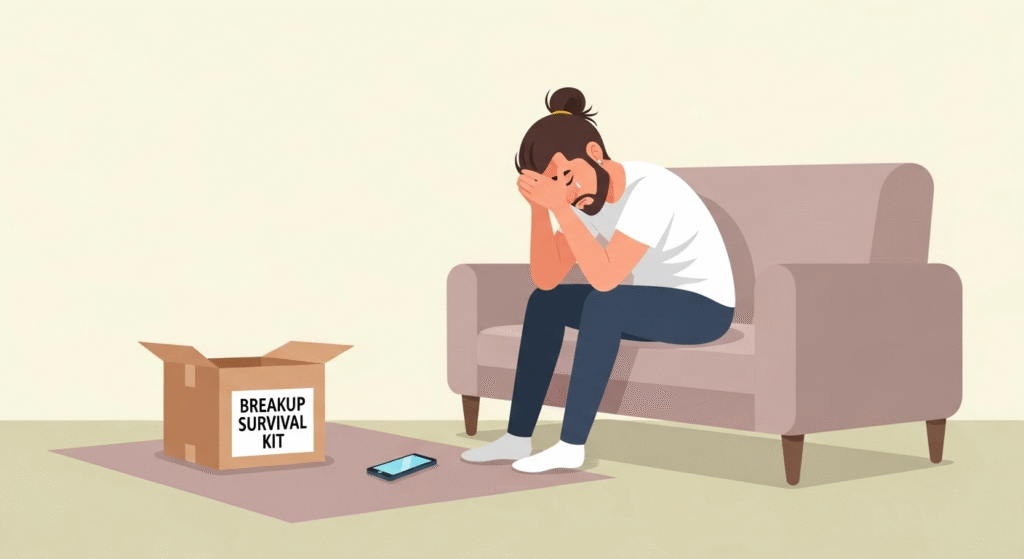
What is a breakup survival kit?
A breakup survival kit is a practical protocol for the first 72 hours after a breakup—the highest-risk window for decisions that complicate recovery. The First 72 Hours Protocol covers the Stability Sequence (hours 1-24), Support Activation (hours 25-48), and the Environment Audit (hours 49-72). It gives structure when your judgment is most impaired so you don't have to make real-time decisions during the highest-stress period.
Conclusion
The first 72 hours are not about healing. They're about not making healing harder.You've done the Stability Sequence. You've activated the right support in the right way. You've audited your environment so your nervous system has somewhere to start stabilizing. You've made it through the highest-risk window for decisions that create new problems.Now comes the longer work—and it is longer. Non-linear. Harder some days than others. Punctuated by trigger spikes that feel like going backward even when they're not.You don't need to have it figured out yet. You don't need to know what the relationship meant, why it ended, or what comes next. Those answers emerge with time and clarity, not in the first 72 hours.What you need right now is exactly what you've done: get through today. Then tomorrow. One 24-hour window at a time.Use Untangle Your Thoughts to track your daily state as you move through the weeks ahead. In 30 days, you'll be able to see what you couldn't feel at hour 72—that you're moving, even when it doesn't feel like it.You made it through the first 72 hours. That matters more than it might seem right now.